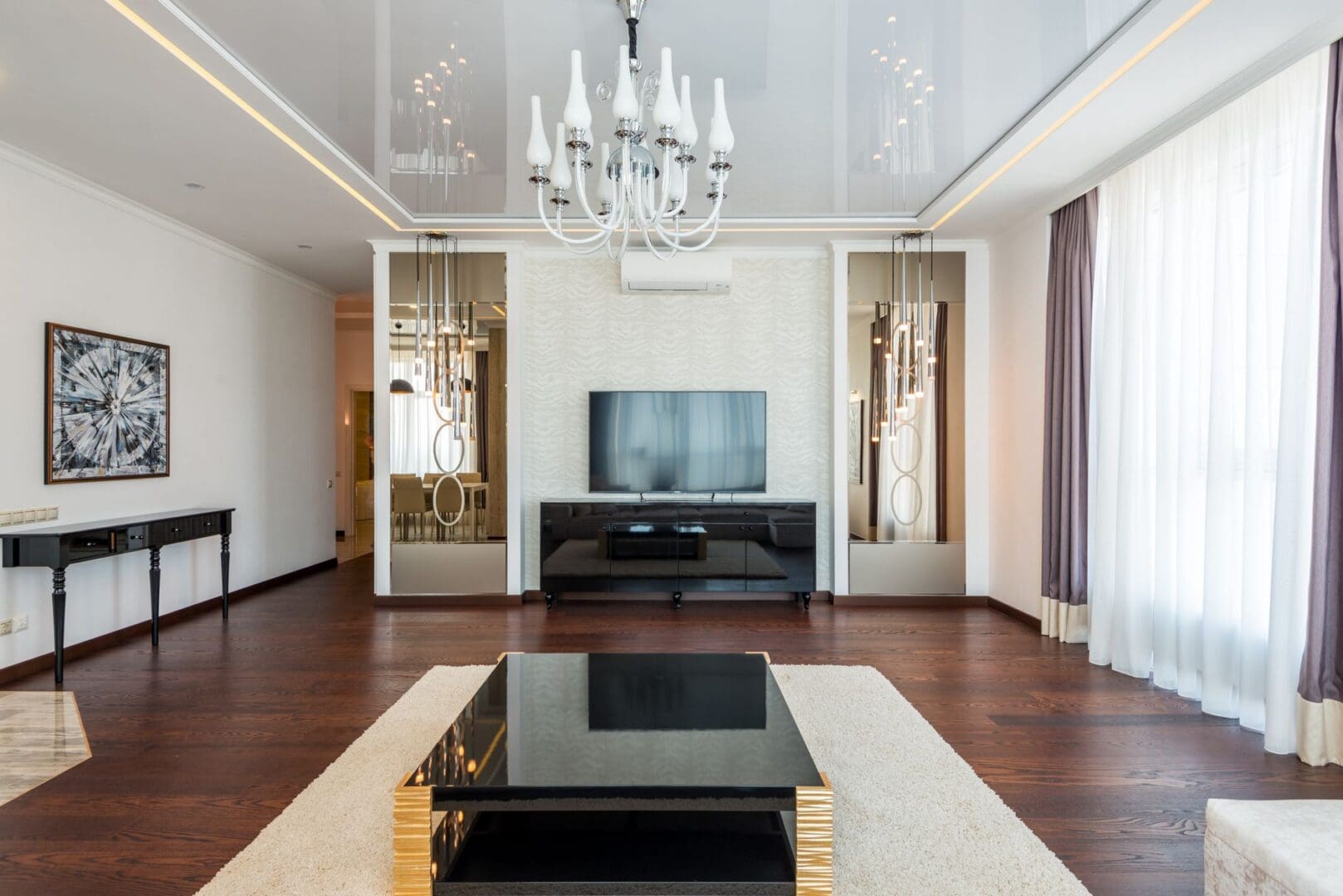
A chandelier can transform your living room from ordinary to unforgettable, but choosing the wrong size or style can throw off your entire space. Unlike task lighting that quietly does its job, a chandelier makes a statement—which means getting it right matters. Whether you’re working with vaulted ceilings or a cozy 10×12 room, here’s how to find a chandelier that actually works for your living room.
Getting the Size Right
The biggest mistake people make is choosing a chandelier that’s too small for their space. A tiny fixture floating in a large room looks like an afterthought, while an oversized piece can make your ceiling feel oppressively low.
Here’s the reliable formula designers use: add your room’s length and width in feet, then convert that sum to inches. That number gives you the ideal diameter for your chandelier. So if your living room is 15 feet by 18 feet, you’re looking at a 33-inch chandelier (15+18=33). This guideline works for most standard 8-10 foot ceilings.
For rooms with higher ceilings—12 feet or more—you can go bolder with both diameter and vertical scale. A fixture that’s 36-48 inches wide with multiple tiers won’t overwhelm the space. Budget chandeliers in standard sizes typically run $150-400, mid-range designer pieces land between $500-1,200, and statement fixtures from high-end manufacturers start around $1,500 and climb quickly from there.
Hanging Height and Placement
Even a gorgeous chandelier looks awkward if it hangs at the wrong height. In living rooms where people walk underneath the fixture, the bottom should sit at least 7 feet above the floor—7.5 feet is even better if your ceilings allow it. This gives you clearance without sacrificing presence.
If your chandelier hangs over a coffee table or seating arrangement, you’ve got more flexibility. Aim for 30-36 inches between the table surface and the bottom of the fixture. This creates intimacy without blocking sightlines across the room.
Placement matters as much as height. Chandeliers work best centered in the room or centered over your main seating area. If your living room is open-concept, center it over the defined living zone rather than the entire combined space. Many fixtures come with adjustable chains or rods—don’t assume the default length is correct for your ceiling height.
Style and Finish Considerations
Your chandelier should feel intentional within your design scheme, not like it wandered in from someone else’s house. Traditional crystal chandeliers with ornate arms suit formal living rooms with classic furnishings, while modern geometric or Sputnik-style fixtures complement contemporary spaces with clean lines.
Transitional chandeliers—think drum shades with subtle detailing or simplified candelabra styles—bridge the gap if your living room mixes old and new. These work especially well in homes where you’re not committed to a single design aesthetic.
Finish choice affects how your chandelier interacts with other metals in the room. Brass and gold finishes add warmth and pair beautifully with wood tones. Matte black creates drama and contrast, especially against white or light ceilings. Brushed nickel and chrome read more neutral and contemporary. You don’t need to match every metal finish perfectly, but keeping a consistent tone (warm vs. cool) helps the room feel cohesive.
Light Output and Bulb Compatibility
A chandelier that doesn’t provide adequate light is just expensive decoration. Before you fall in love with a design, check how many bulbs it holds and what wattage it supports. Most living rooms need 200-400 watts total for ambient lighting, though this varies with room size and how much natural light you get.
Look for fixtures that accommodate LED bulbs, which give you brightness options without the energy costs. Some chandeliers specify candelabra bulbs, others take standard base bulbs—knowing this upfront prevents the frustrating discovery that your perfect fixture requires specialty bulbs at $12 each.
Installing a dimmer switch is non-negotiable for living room chandeliers. You’ll want bright light for reading or cleaning, but softer illumination for movie nights or entertaining. Just verify your chosen fixture is dimmable—not all LED-compatible chandeliers play nicely with all dimmer types.
Choosing a chandelier doesn’t have to feel overwhelming when you know what to measure and what questions to ask. Focus on getting the size and scale right first, then narrow down style and finish based on your existing decor. The perfect chandelier should feel like it’s always belonged in your living room, elevating the space while providing the light you actually need. Take your room measurements, consider your ceiling height, and look for fixtures that check both the practical and beautiful boxes—you’ll know the right one when you see it.
Add your room’s length and width in feet, then convert that number to inches for your chandelier’s diameter. For example, a 12×14 room (26 feet total) works well with a 26-inch wide chandelier. This formula ensures your fixture looks proportional to the space.
How low should a chandelier hang in a living room?
Hang your chandelier so the bottom sits at least 7 feet above the floor in living rooms without furniture underneath. If it’s centered over a coffee table, aim for 30-36 inches of clearance above the table surface. This prevents head-bumping while maintaining visual impact.
Can a chandelier be too big for a living room?
Yes, an oversized chandelier can overwhelm a room and make the ceiling feel lower. Stick to the length-plus-width formula for sizing, and ensure the fixture doesn’t extend beyond the edges of your main seating area. Scale matters more than you think.
What style chandelier is best for a modern living room?
Modern living rooms pair well with geometric chandeliers, Sputnik-style fixtures, or minimalist drum chandeliers with clean lines. Look for finishes like brushed nickel, matte black, or aged brass. Avoid overly ornate or traditional crystal styles unless you’re intentionally mixing design periods.
Should a living room chandelier have a dimmer?
Absolutely—a dimmer is essential for chandelier functionality in living rooms. It lets you adjust lighting for different activities, from bright task lighting to ambient evening glow. Make sure your fixture is compatible with dimmer switches before purchasing.
If you’ve been hitting snooze repeatedly or dragging yourself out of bed feeling groggy, you’re not alone. Waking up to a jarring alarm in a dark room works against your body’s natural rhythms, especially during winter months. A sunrise alarm clock mimics natural dawn, gradually filling your room with light to ease you awake. But […]
Waking up at 3 a.m. with a sweaty neck and flipping your pillow to the cool side for the fourth time isn’t just annoying—it’s robbing you of quality sleep. If you’re a hot sleeper, your pillow might be trapping heat against your head and neck all night long. The good news? The right cooling pillow […]
If you’re working from home or spending hours at your desk, you’ve probably noticed that not all chairs are created equal. That bargain office chair seemed fine at first, but now your back aches by mid-afternoon. You’ve been eyeing ergonomic chairs, but with price tags that can run three to ten times higher than regular […]