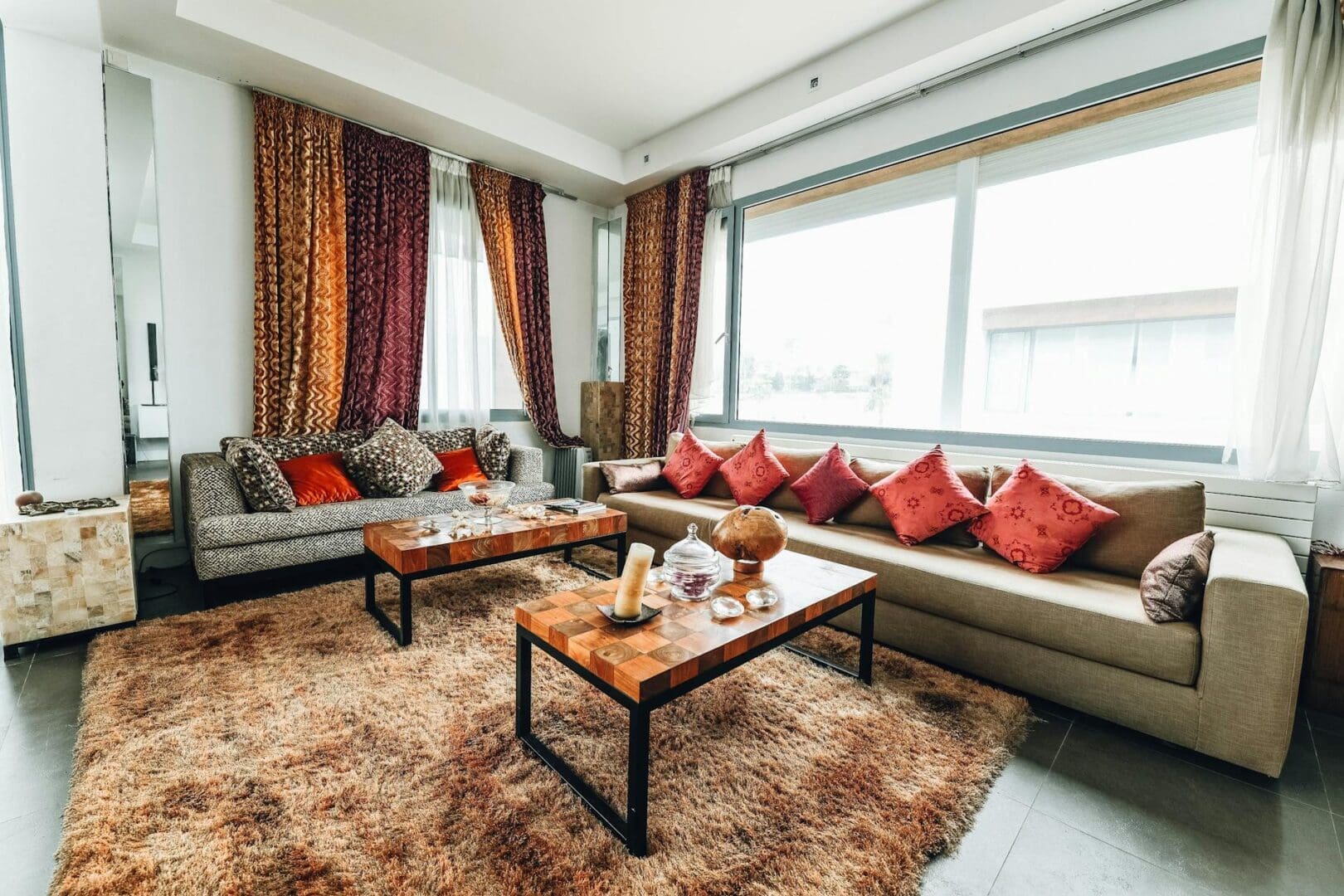
If your living room feels a little flat or you’re working with a rug that’s just not quite big enough, layering rugs might be exactly what you need. This designer trick adds depth, texture, and visual interest while solving practical problems like covering worn spots or defining separate zones. The best part? It’s more forgiving than you’d think, as long as you understand a few key principles.
Getting the Base Layer Right
Your bottom rug is the foundation of the whole look, so start here. This should be your larger rug—typically a neutral jute, sisal, seagrass, or a flatweave in a solid or subtle pattern. Think of it as the anchor that grounds your furniture arrangement.
For a standard living room seating area, you’ll want a base rug that’s at least 8×10 feet, though 9×12 feet works better if your room can handle it. The rule here is simple: your sofa and chairs should sit on this rug, even if it’s just the front legs. If your base rug is too small, the layered look will feel disconnected rather than intentional.
Natural fiber rugs make excellent base layers because they’re relatively affordable (expect to spend $200-$600 for good quality), durable, and their texture adds warmth without competing visually. A simple jute rug in a chunky weave or a flatweave wool rug in cream or gray gives you plenty of flexibility for your top layer.
Choosing Your Top Layer
This is where personality comes in. Your top rug should be smaller—typically 5×7 or 6×9 feet—and positioned to define a specific area, like the space in front of your sofa or under your coffee table.
Look for rugs with more visual interest here: vintage Persian or Turkish rugs, colorful Moroccan styles, graphic geometric patterns, or plush sheepskin and cowhides all work beautifully. The key is contrast. If your base is textured and neutral, your top layer can introduce color and pattern. If your base has subtle pattern, keep the top layer more about texture than busy design.
Budget-wise, you can find great vintage-style options for $150-$400 in smaller sizes, while authentic vintage pieces run $400-$1,200 depending on age and condition. For a luxe natural hide, expect $300-$800.
Texture and Pattern Combinations That Work
The most successful rug layering combines different textures rather than competing patterns. Here are combinations that consistently look pulled-together:
Flat jute base with a plush vintage Persian or Oushak rug on top
Neutral sisal base with a graphic black-and-white striped or geometric rug
Textured wool flatweave base with a sheepskin or cowhide accent
Subtle herringbone or braided base with a colorful Moroccan or kilim rug
What doesn’t work? Two high-pile rugs stacked together (they’ll shift constantly), or two competing bold patterns unless you really know what you’re doing. When in doubt, keep one layer quiet and let the other make the statement.
Placement and Proportion Tips
Placement matters more than you might think. The top rug shouldn’t sit dead-center on the base rug—that looks too precious. Instead, position it slightly off-center or push it closer to your seating area so it feels organic rather than staged.
Leave at least 8-12 inches of your base rug visible on all sides of your top rug. This border of the bottom layer is what makes the layering read as intentional. If your top rug covers too much of the base, you lose the whole effect.
Make sure your coffee table sits completely on the top rug, or at least has all four legs on it. Half-on, half-off looks unfinished. If your coffee table is large, you might skip it entirely and let the layered rugs be the focal point with just seating around them.
Layering rugs gives you flexibility to work with what you already own, introduce new colors without committing to a full room redo, or make a small rug work in a larger space. Start with a neutral, generously sized base, add a smaller statement piece on top, and make sure there’s enough contrast in texture or pattern to let both rugs shine. Once you see how much dimension it adds, you might find yourself layering rugs in every room.
There’s nothing quite like settling in for movie night at home, but harsh overhead lighting can ruin the whole experience. Too bright, and you’re squinting at a washed-out screen. Too dark, and you’re fumbling for the remote or straining your eyes. Getting your living room lighting right for movie watching isn’t complicated—it just takes the […]
You probably reach for your phone to change the temperature, lock your doors, or check who’s at the front door—so why are you still walking across the room to flip light switches? Smart lighting transforms your living room from a space with basic on-off switches into one that adapts to movie nights, dinner parties, reading […]
A chandelier can transform your living room from ordinary to unforgettable, but choosing the wrong size or style can throw off your entire space. Unlike task lighting that quietly does its job, a chandelier makes a statement—which means getting it right matters. Whether you’re working with vaulted ceilings or a cozy 10×12 room, here’s how […]