Recessed lighting can transform your bedroom from a dimly-lit cave into a comfortable, well-lit retreat—but only if you choose the right fixtures and place them thoughtfully. Unlike a living room where bright task lighting might be the priority, your bedroom needs a layered approach that supports everything from getting dressed in the morning to winding down at night. Here’s what you need to know to get it right.
Understanding Bulb Temperature and Brightness
The color temperature of your bulbs matters more in a bedroom than almost any other room. Look for bulbs rated between 2700K and 3000K—these warm white tones create a cozy, relaxing atmosphere that helps signal to your body it’s time to wind down. Anything above 3500K starts to feel too clinical and can actually interfere with your sleep quality.
For brightness, you’ll want bulbs that produce 400-600 lumens per fixture. This gives you enough light to see clearly without flooding the room with harsh illumination. The key is having enough fixtures that you’re not relying on each one to do too much work. A bedroom that’s over-lit feels more like an office than a sanctuary.
Dimming capability is non-negotiable for bedroom recessed lighting. Even if you think you won’t use it, having the ability to dial down the brightness in the evening makes an enormous difference in how the room feels. Make sure both your bulbs and the dimmer switch are compatible—LED bulbs require LED-compatible dimmers to avoid flickering and buzzing.
Sizing and Spacing Your Fixtures
Four-inch and five-inch recessed lights are the standard choices for bedrooms. Four-inch housings work beautifully in rooms with standard 8-foot ceilings and give you more flexibility in placement. Five-inch fixtures spread light over a wider area, which can be helpful in larger bedrooms or those with higher ceilings.
The spacing formula is straightforward: divide your ceiling height by two to determine how far apart fixtures should be. For an 8-foot ceiling, that’s 4 feet between lights. Position your first row of lights about 2-3 feet from the walls—any closer and you’ll create unflattering shadows on wall art and furniture.
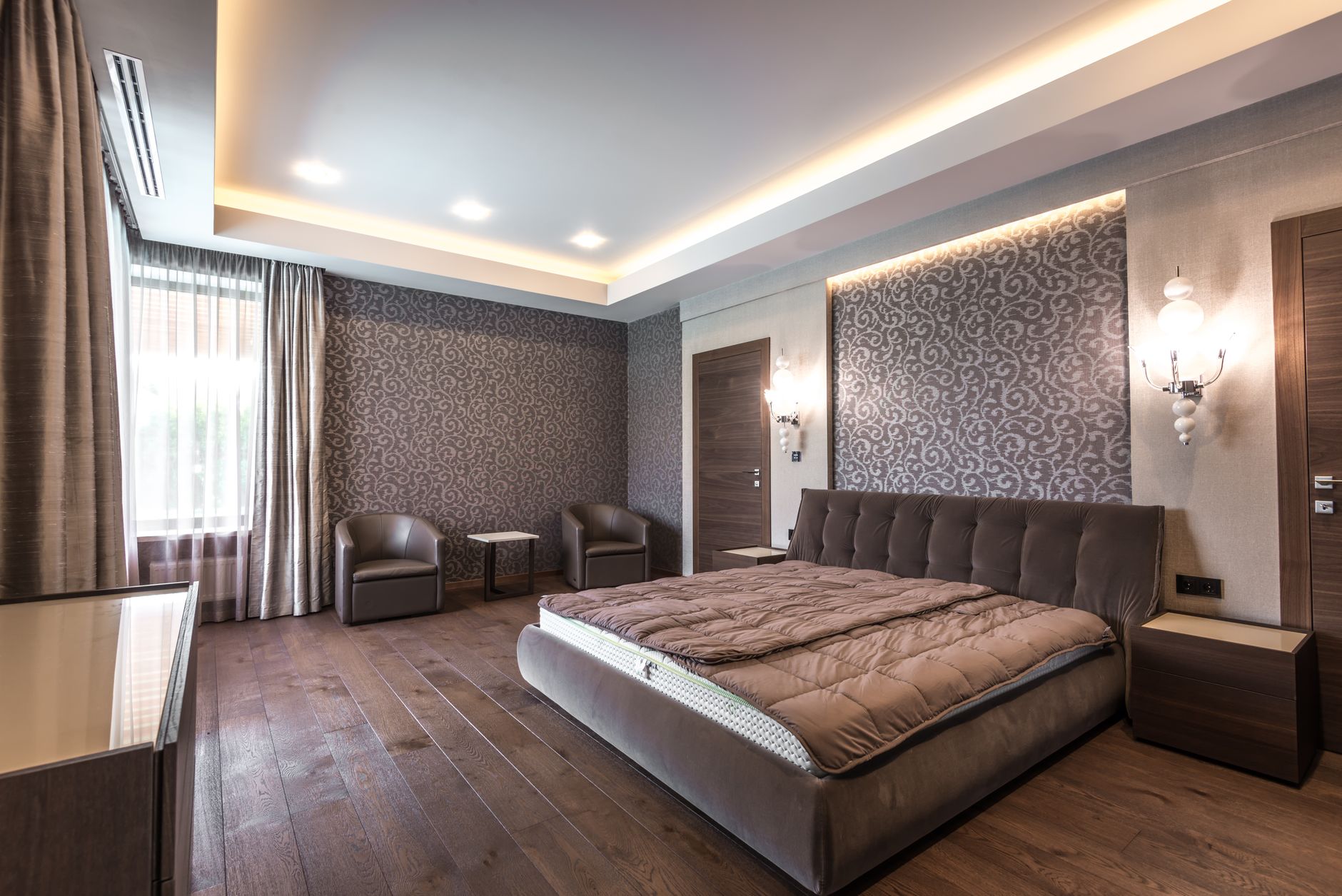
Think carefully about placement over the bed itself. Lights directly overhead can be uncomfortable when you’re lying down and create harsh shadows that make reading difficult. Instead, position fixtures toward the sides of the bed or use them to create a perimeter lighting effect around the room. For task lighting while reading, you’re better off with bedside lamps or wall sconces.
Trim Styles and Housing Types
The trim is the visible ring around your recessed light, and it has a bigger impact on the room’s look than you might expect. White baffle trims are the most popular for bedrooms—they minimize glare and blend seamlessly with white ceilings. If you have a contemporary space, consider black baffle or brushed nickel trims for a more intentional design statement.
For angled or cathedral ceilings, you’ll need adjustable or eyeball trims that let you direct light where you need it. These cost slightly more but prevent awkward dark spots that fixed-position lights can create on sloped surfaces.
Housing type depends on what’s above your ceiling. IC-rated housings are required if there’s insulation in contact with the fixture, while airtight (AT) rated housings prevent conditioned air from escaping into your attic. New construction housings are easiest to install before drywall goes up, but remodel housings with spring clips work well if you’re updating an existing bedroom.
Budget Considerations and Installation
Budget recessed lighting kits start around $15-25 per fixture and include basic housings with standard trims. These work fine for straightforward installations in rooms with accessible attic space above. Mid-range options ($30-60 per fixture) offer better build quality, integrated LED modules that last 20+ years, and smoother dimming performance.
Premium fixtures ($75-150 each) give you advanced features like color-tuning technology that shifts from energizing daylight tones in the morning to warm evening hues, plus smart home integration and app control. For most bedrooms, mid-range fixtures hit the sweet spot of quality and value.
Professional installation typically runs $100-200 per light when running new wiring is involved, though simple retrofits in accessible ceilings cost less. If you’re handy and your local code allows homeowner electrical work, remodel housings are DIY-friendly—just make sure your circuit can handle the additional load.
Choosing recessed lighting for your bedroom comes down to creating flexible, comfortable illumination that supports how you actually use the space. Warm, dimmable fixtures properly spaced around the room give you the control to shift from functional morning light to relaxing evening ambiance. Take the time to plan your layout thoughtfully, and you’ll end up with lighting that makes your bedroom feel like the retreat it should be.
What color temperature is best for bedroom recessed lighting?
Warm white bulbs in the 2700K to 3000K range work best for bedrooms. These warmer tones create a relaxing atmosphere and won’t interfere with your natural sleep cycle like cooler, blue-toned light can.
How many recessed lights do I need in a bedroom?
Plan for one recessed light per 25-30 square feet of ceiling space as a general rule. A 12×12 foot bedroom typically needs 4-6 lights, depending on ceiling height and whether you’re supplementing with lamps or wall sconces.
Should bedroom recessed lights be dimmable?
Yes, dimmable recessed lights are essential for bedrooms. They allow you to adjust brightness throughout the day and create a relaxing environment before sleep, which is difficult to achieve with standard on-off switches.
What size recessed lights should I use in a bedroom?
Four-inch or five-inch housings work best for most bedrooms. Four-inch lights offer more placement flexibility and work well in rooms with 8-foot ceilings, while five-inch fixtures provide broader light distribution in larger spaces.
Can you put recessed lighting over a bed?
You can, but position lights toward the outer edges of the bed rather than directly overhead. Placing recessed lights directly above where you sleep can be uncomfortable and create unflattering shadows when reading in bed.
Shopping for a dresser for your child’s room feels different than buying one for yourself. You’re not just thinking about today—you’re wondering if it’ll survive the toddler years, hold up through elementary school, and maybe even make it to the teenage bedroom. The good news? With the right approach, you can find a dresser that […]
You’ve found the perfect bed frame, but now your old dresser looks completely out of place. Or maybe you’re starting fresh and wondering whether you need to buy a matching bedroom set. The truth is, coordinating your dresser and bed frame isn’t about finding exact matches—it’s about creating visual harmony through smart choices about style, […]
Adding a dresser to your walk-in closet can transform it from a simple hanging space into a fully functional dressing room. But unlike choosing a dresser for your bedroom, closet dressers have different requirements—they need to fit within existing dimensions, complement built-in systems, and maximize storage without creating obstacles. Whether you’re designing a new closet […]