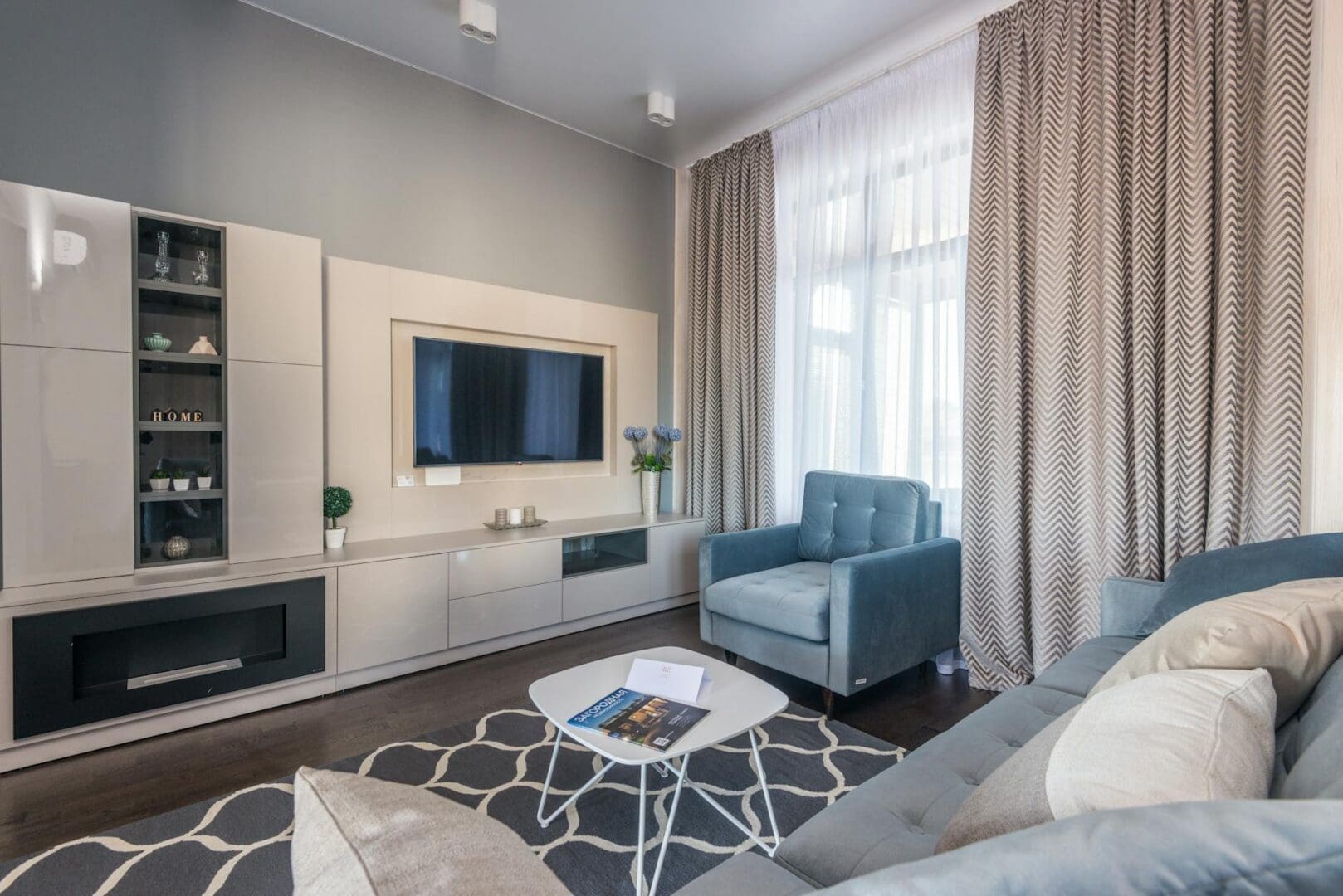
Standing in front of a wall of curtain options can feel overwhelming. Too short and they’ll look like an afterthought. Too heavy and your bright living room becomes a cave. The right curtains, though? They pull everything together and make your windows look like you actually planned them that way.
Here’s what matters when you’re choosing curtains that’ll work with your living room, not against it.
Getting the Length and Width Right
This is where most people accidentally make their rooms look smaller or their ceilings look lower. The foolproof approach: hang your curtain rod 4-6 inches above your window frame (or even higher, up to the ceiling if you want to add drama), and let your curtains just kiss the floor or puddle slightly.
For width, you want curtains that look full when closed, not stretched tight across the window. A good rule is to choose panels that measure 2-2.5 times your window width combined. If your window is 48 inches wide, you’re looking at panels that total 96-120 inches across. Most standard panels come in 50-54 inch widths, so you’d use two panels for that window.
Ready-made panels typically come in 63, 84, 95, 108, and 120-inch lengths. For standard 8-foot ceilings with a window that sits about 12 inches from the floor, 84-inch or 95-inch panels usually work well. Measure from where you’ll place the rod to the floor, then subtract an inch or two.
Choosing the Right Fabric and Opacity
The fabric you choose changes how your living room feels and functions. Light linen or cotton blends give you that breezy, relaxed look and filter light beautifully, but they won’t give you much privacy at night when your lights are on. Budget-friendly options start around $20-40 per panel.
Lined curtains are the workhorse option for living rooms. They hang better than unlined panels, provide privacy, and offer some light control without going full blackout. You’ll find quality lined curtains in the $40-100 per panel range, with velvet and heavier fabrics pushing toward the higher end.
Room-darkening or blackout curtains work great if your living room doubles as a media room or if you deal with harsh afternoon sun. They’re typically $50-150 per panel depending on fabric quality. Just remember that blackout curtains in heavy fabrics can feel formal, so consider whether that matches your room’s vibe.
Texture matters too. Linen adds casual elegance, velvet brings richness and sound absorption, and cotton blends are easy-care and versatile. If you have pets or kids, look for machine-washable fabrics.
Matching Style to Your Space
Your curtain style should feel connected to your living room’s overall look. Grommet-top curtains with metal rings create clean, contemporary lines and slide easily—perfect for modern spaces. They typically hang in casual, uniform folds.
Rod pocket curtains slip directly onto the rod and create a gathered look that reads traditional or cottage-style. They’re usually the most budget-friendly but can be tricky to open and close smoothly.
Tab-top curtains have fabric loops and offer a relaxed, informal look that works in casual spaces. Pinch-pleat or tailored-pleat curtains look polished and custom, ideal for traditional or formal living rooms, though they typically require rings or hooks.
Color and pattern deserve careful thought. Solid neutrals are safe and versatile—they’ll work as you change other elements in your room. Patterns add personality but can feel overwhelming in a small space or if you already have patterned furniture. When in doubt, bring home samples and live with them for a few days.
Hardware That Holds Up
Don’t overlook the rod and brackets. Flimsy hardware sags under the weight of curtains, especially lined or heavier fabrics. Look for rods that can support at least 20 pounds, with a center bracket for windows over 60 inches wide.
Rod diameter matters for the look you’re after. Standard 1-inch rods work for lightweight to medium curtains and feel modern or transitional. Thicker 1.5 to 2-inch rods make a statement and handle heavy fabrics better, but make sure your curtain header style accommodates them.
Budget $30-60 for basic but sturdy hardware sets, or $80-200+ for decorative options with finials that become part of your room’s design. Finish should coordinate with other metals in your space—your lamps, picture frames, or door hardware.
Choosing curtains really comes down to measuring carefully, picking a fabric weight that matches how you use the room, and selecting a style that feels cohesive with your furniture. Start with these basics right, and you’ll end up with windows that look finished and intentional rather than like an afterthought you hung on a Saturday afternoon.
You need more storage in your living room, but a bulky bookcase feels too heavy and floating shelves aren’t cutting it. A credenza might be exactly what you’re looking for—it’s that low-profile cabinet that gives you tons of hidden storage while creating a beautiful surface for lamps, plants, and the things you actually want to […]
If you’ve been hitting snooze repeatedly or dragging yourself out of bed feeling groggy, you’re not alone. Waking up to a jarring alarm in a dark room works against your body’s natural rhythms, especially during winter months. A sunrise alarm clock mimics natural dawn, gradually filling your room with light to ease you awake. But […]
Waking up at 3 a.m. with a sweaty neck and flipping your pillow to the cool side for the fourth time isn’t just annoying—it’s robbing you of quality sleep. If you’re a hot sleeper, your pillow might be trapping heat against your head and neck all night long. The good news? The right cooling pillow […]