Your backyard has potential, but right now it disappears the moment the sun goes down. Good landscape lighting changes that—it extends your living space into the evening hours, highlights your best features, and makes your home feel more inviting from the curb. But walk into any lighting section and you’ll face dozens of options with wildly different price tags and installation requirements. Here’s what actually matters when you’re shopping.
Decide Between Low-Voltage, Solar, and Line-Voltage Systems
This is your first fork in the road, and it shapes everything else. Low-voltage systems (usually 12V) are the sweet spot for most homeowners—they’re safe to install yourself, energy-efficient, and powerful enough to create real impact. Expect to spend $200-$600 for a starter kit with transformer and 6-8 fixtures, with quality options from brands that offer expandable systems.
Solar lights are tempting because there’s no wiring involved, but be realistic about their limitations. They work fine for subtle path markers in sunny areas, typically running $15-$40 per fixture, but they won’t deliver the brightness or reliability you need for accent lighting or shaded yards. If you go solar, budget for replacing batteries every 1-2 years.
Line-voltage systems (120V) offer the most powerful illumination and are worth considering if you’re lighting large trees, long driveways, or want that high-end landscape look. You’ll need an electrician for installation, and fixture costs start around $80-$150 each, but the results are noticeably more dramatic than low-voltage alternatives.
Choose the Right Fixture Types for Each Job
Professional landscape designs use a mix of fixture types, and you should too. Path lights are the workhorses—they guide foot traffic and typically stand 18-24 inches tall. Look for downward-facing designs that minimize glare, usually $30-$70 per fixture for well-made options.
Spotlights and well lights create your “wow” moments by uplighting trees, architectural features, or sculptures. Position them at the base of what you’re highlighting, and choose fixtures with adjustable heads so you can fine-tune the angle. Quality spotlights with brass or copper construction run $50-$120 each but will outlast cheaper alternatives by years.
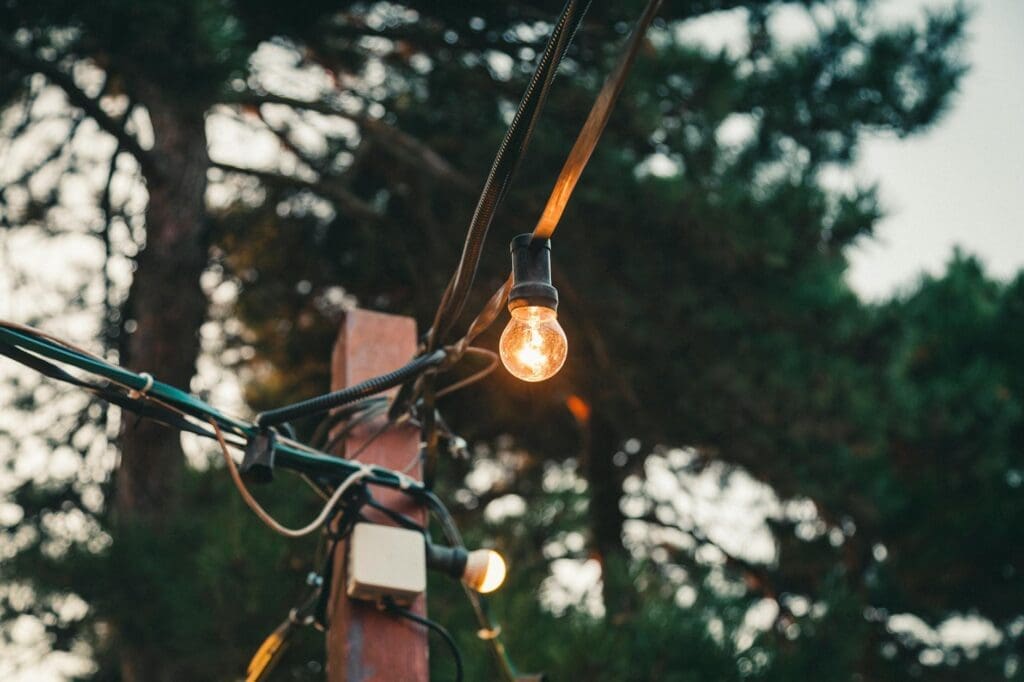
Hardscape lights—those small recessed or surface-mount fixtures for steps, walls, and deck posts—serve double duty by adding safety and ambiance. They’re typically sold individually at $25-$60 each. If you have a deck or patio, consider string lights or pendant fixtures rated for outdoor use to create an overhead layer of light that feels more like an outdoor room.
Consider Bulb Type and Color Temperature
LED bulbs are essentially your only option now, and that’s actually good news—they last 25,000+ hours and use 75% less energy than old halogen bulbs. What matters more is color temperature, measured in Kelvins. For landscape lighting, stay in the 2700K-3000K range (warm white). This creates a welcoming, natural glow that complements most plantings and architecture. Anything cooler looks institutional and uninviting.
Pay attention to beam angles too. Narrow beams (15-25 degrees) work for tall trees and focused accents, while wider beams (35-60 degrees) suit path lighting and washing walls with light. Some higher-end fixtures include interchangeable lenses or adjustable optics, which is worth the extra $15-$30 per fixture if you’re not sure about placement yet.
Think About Materials and Long-Term Durability
Your landscape lighting lives outside year-round, facing rain, snow, sprinklers, and lawn equipment. Brass, copper, and stainless steel fixtures cost more upfront ($60-$150 vs. $20-$40 for plastic or thin aluminum) but they resist corrosion and won’t need replacing in three years. If you’re investing in a low-voltage system you plan to expand, spending more on quality fixtures now makes sense.
Check the IP rating—IP65 or higher means the fixture can handle direct water spray, not just light rain. Look for sealed cable connections and fixtures with replaceable components. Some budget kits use proprietary connectors that make expansion difficult, while better systems use standard wire connectors you can work with yourself.
Choosing landscape lighting is really about deciding how you want to use your backyard after dark. Start with the areas you’ll use most—the path from driveway to front door, your patio, or that Japanese maple you spent too much on—and build from there. Most systems are expandable, so you don’t need to light everything at once. Focus on creating a few well-lit focal points rather than spreading fixtures too thin, and you’ll end up with a backyard that actually invites you outside instead of one that just has some lights in it.
There’s something wonderfully ironic about the Adirondack chair’s origin story. Back in 1903, Thomas Lee was vacationing in Westport, New York, frustrated by the lack of comfortable outdoor seating that could handle the sloped terrain of his property. So he built a wide-backed, slatted chair with a reclined seat—and accidentally created an icon. Today, you’ll […]
A dark backyard feels smaller, less usable, and honestly a bit uninviting once the sun goes down. Whether you’re trying to make your outdoor space safer, extend your entertaining hours, or simply discourage unwanted visitors, the right flood lights can completely transform how you use your yard after dark. The challenge is figuring out which […]
You’ve found the perfect outdoor rug to tie your patio together, but three months later it’s faded, mildewed, or falling apart. Sound familiar? The material makes all the difference when it comes to outdoor rugs that actually last. Unlike indoor rugs that live cushy lives away from the elements, your outdoor rug needs to handle […]