Your bedroom needs to do a lot of heavy lifting. It’s where you wind down with a book, get ready for work, maybe catch up on emails, and ultimately drift off to sleep. The problem? Most bedrooms have one overhead light that’s either blazing bright or completely off. That single fixture can’t possibly support all these different activities and moods, which is why so many people end up scrolling their phones in bed—the lighting just doesn’t work for anything else.
The secret to a bedroom that actually adapts to your life is layering multiple light sources at different heights and intensities. Here’s how to build a lighting plan that shifts with whatever mood you’re after.
Start With Your Ambient Base Layer
Think of ambient lighting as your foundation—it’s the general illumination that fills the room. This usually comes from ceiling fixtures, but here’s the thing: a harsh overhead light is nobody’s friend in a bedroom. If you’re stuck with a basic ceiling fixture, swap in a warm-toned LED bulb (look for 2700K color temperature) and consider adding a dimmer switch. That $15-30 investment changes everything.
Better options include flush-mount fixtures with fabric or frosted glass shades that diffuse light softly, or if you have the ceiling height, a pendant light with a dimmer. Budget-friendly flush mounts start around $50-80, while statement pendants can run $150-400. For rooms without overhead lighting, a torchiere floor lamp pointed at the ceiling creates nice ambient bounce light.
Add Task Lighting Where You Actually Need It
Task lighting is all about function—bright enough to read, work, or get dressed without straining your eyes. Bedside table lamps are the classic choice here, and you’ll want them at least 24-27 inches tall so the bottom of the shade sits at eye level when you’re sitting up in bed. Swing-arm wall sconces are even better if you’re short on nightstand space, and they free up room for your water glass and book.
For reading, look for bulbs in the 400-500 lumen range (that’s roughly 40-50 watt equivalent). Three-way bulbs are incredibly useful because you can adjust brightness without getting out of bed. If you have a vanity or dressing area, add dedicated lighting there too—vertical sconces on either side of a mirror provide the most flattering, shadow-free light. Table lamps typically range from $40-150 for solid options, while hardwired sconces run $80-250 plus installation.
Layer In Accent Lighting for Atmosphere
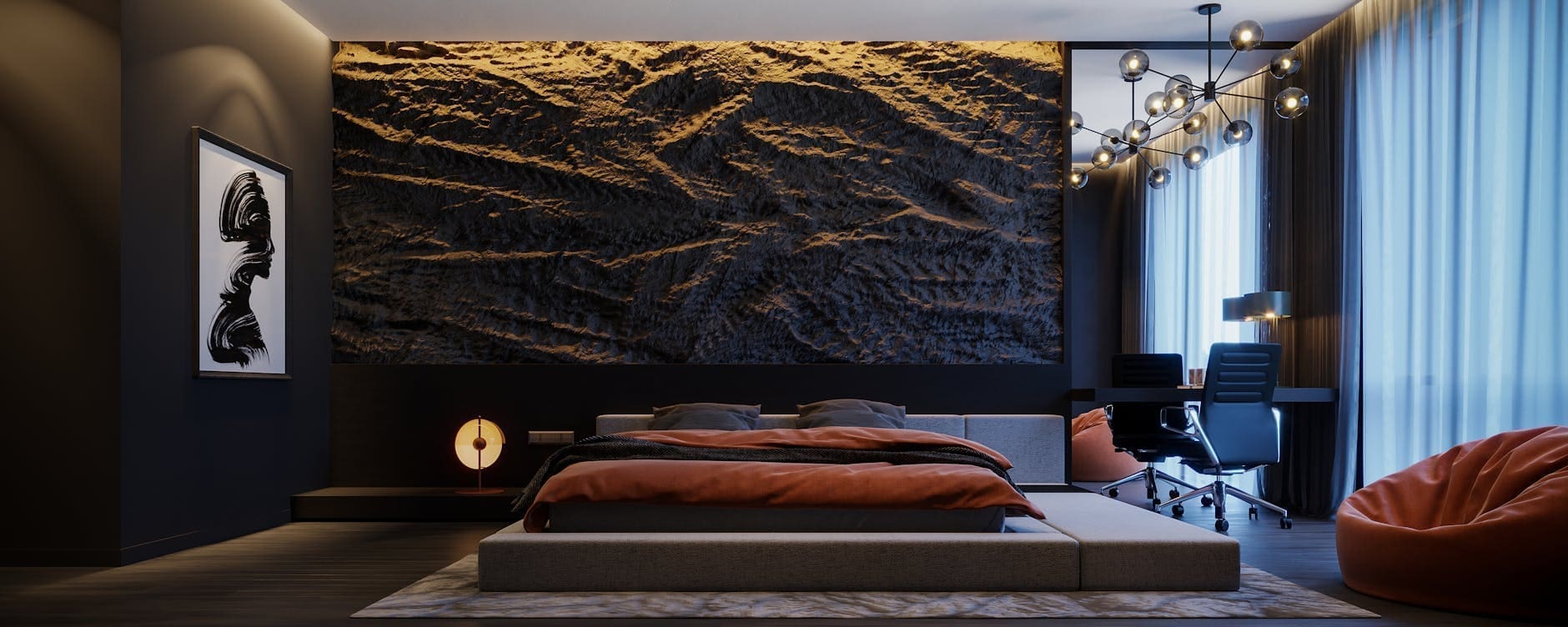
This is where mood lighting really shines. Accent lights aren’t about illuminating tasks—they’re about creating ambiance and visual interest. LED strip lights behind a headboard or under a floating bed frame add a soft glow that’s perfect for winding down. Small picture lights can highlight artwork, and even a string of Edison bulbs or a small table lamp on a dresser contributes to that layered, boutique hotel feeling.
The key with accent lighting is keeping it subtle and warm. You’re adding pockets of light at different levels to make the space feel dimensional and cozy. This is also where smart bulbs earn their keep—being able to dim lights from bed or set schedules so they gradually brighten in the morning is genuinely useful, not just a gimmick. Basic LED strips start around $15-25, while quality smart bulbs run $10-15 each.
Control Is Everything
Having all these light sources doesn’t help if you can’t adjust them easily. Dimmer switches should be your first priority—they work on most LED bulbs now and typically cost $15-30 per switch. For lamps without built-in dimmers, plug-in dimmer modules are available for under $20.
Consider putting your ambient and accent lights on separate switches or circuits so you can use them independently. Late evening might mean just the accent lighting and one bedside lamp, while getting ready in the morning might need everything at full brightness. Smart switches and bulbs add convenience, but traditional dimmers work perfectly fine if you’d rather keep it simple.
The real magic happens when you can move through different lighting “scenes” throughout your evening—bright and energizing after work, medium for reading or folding laundry, low and warm for the hour before sleep. With three or four light sources on separate controls, you’re not stuck with just “on” or “off.” You’re giving yourself options that actually match how you use the room, which makes your bedroom feel less like just a place you sleep and more like a space that works for you.
Shopping for a dresser for your child’s room feels different than buying one for yourself. You’re not just thinking about today—you’re wondering if it’ll survive the toddler years, hold up through elementary school, and maybe even make it to the teenage bedroom. The good news? With the right approach, you can find a dresser that […]
You’ve found the perfect bed frame, but now your old dresser looks completely out of place. Or maybe you’re starting fresh and wondering whether you need to buy a matching bedroom set. The truth is, coordinating your dresser and bed frame isn’t about finding exact matches—it’s about creating visual harmony through smart choices about style, […]
Adding a dresser to your walk-in closet can transform it from a simple hanging space into a fully functional dressing room. But unlike choosing a dresser for your bedroom, closet dressers have different requirements—they need to fit within existing dimensions, complement built-in systems, and maximize storage without creating obstacles. Whether you’re designing a new closet […]