Most people think of the 1970s as the era of shag carpeting, earth tones, and bean bag chairs. And they’re not wrong. But beneath the avocado green and harvest gold was something much bigger — the beginning of the greatest era in American furniture manufacturing history.
A Perfect Storm for Furniture
The golden age of American furniture manufacturing ran from the early 1970s through the mid-1990s, and it wasn’t an accident. It was the result of one of the most powerful economic forces in American history: the Baby Boom generation growing up.
The Baby Boomers — the largest generation in American history at the time — were coming of age in the early 1970s. They were getting married, starting families, and buying homes at a pace the country had never seen before. In fact, the number of homes built in the 1970s surpassed any other decade before or after.
And every single one of those homes needed furniture.
The Numbers Tell the Story
Annual manufacturers’ shipments of wood and upholstered furniture products grew from $4.5 billion in 1970 to $16.3 billion by the mid-1990s. American furniture factories were running at full capacity. The industry employed hundreds of thousands of workers. Towns like High Point, North Carolina became the furniture capitals of the world, hosting the largest furniture trade show on the planet twice a year.
Brands like Broyhill, Lane, Drexel Heritage, Ethan Allen, and La-Z-Boy became household names. The American living room had never been more important — or better furnished.
The Look of an Era
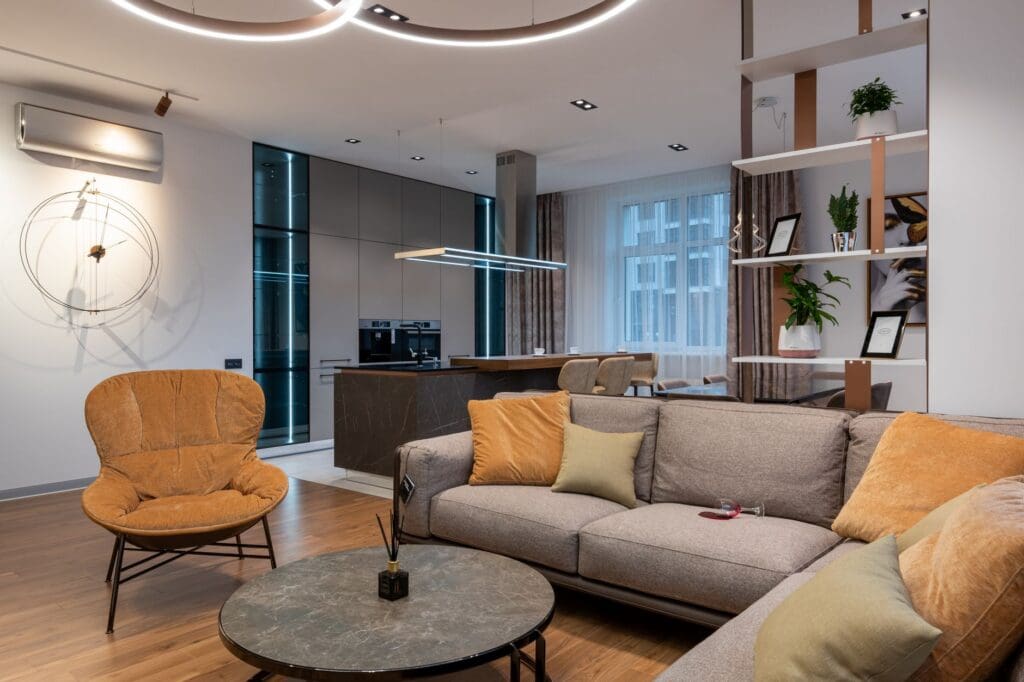
The furniture of the early 1970s was unmistakable. Earth tones dominated — burnt orange, avocado green, harvest gold, and deep walnut brown. Oversized sofas with low profiles. Modular seating systems. Plush sectionals. Built-in storage solutions that made suburban living feel luxurious.
Italian designers were pushing boundaries with bold use of plastic, chrome, and leather. American manufacturers responded with their own vision of modern comfort — furniture that was softer, bigger, and more relaxed than anything that had come before.
The La-Z-Boy recliner, invented decades earlier in a Michigan garage from orange crates, became one of the decade’s defining furniture pieces. The recliner wasn’t just a chair — it was a symbol of the American good life.
High Point: The Capital of Comfort
At the center of it all was High Point, North Carolina. Already a furniture manufacturing hub since the late 1800s, High Point exploded during the golden age. By the 1980s, North Carolina alone employed over 90,000 people in furniture manufacturing and was adding nearly 200 new furniture companies a year.
The High Point Market — the International Home Furnishings Market — became the largest furniture trade show in the world, drawing tens of thousands of buyers, designers, and manufacturers twice a year to see what was next.
When the Golden Age Ended
The golden age of American furniture manufacturing began to fade in the mid-1990s as globalization reshaped the industry. Free trade agreements opened the door to overseas production, and factories that had operated for decades began to close. Jobs moved to Asia. China eventually became the dominant global supplier of furniture.
The American furniture industry never fully recovered its manufacturing dominance. But the passion for well-designed, comfortable, functional furniture never went away.
Some Things Never Go Out of Style
Americans still spend billions each year furnishing their homes. The desire for the perfect sofa, the right dining table, the most comfortable mattress — none of that changed when the factories moved overseas.
If anything, today’s furniture buyers are more informed, more design-conscious, and more intentional than ever. The golden age may be over, but the love of a well-furnished home is here to stay.