Knocking down walls opened up your floor plan, but now you’re staring at one big room wondering where the dining area actually begins and ends. Or maybe you’ve just moved into an open layout and can’t figure out how to make the dining space feel intentional rather than like a few chairs floating in the middle of nowhere. Creating a defined dining area within an open concept home is all about smart furniture choices and visual cues that say “this is where we gather to eat” without building barriers.
Define Your Dining Zone With the Right Table
Your dining table is the anchor that establishes where your dining area lives. In an open layout, size matters more than ever. A table that’s too small disappears into the larger space, while an oversized piece can block traffic flow between your kitchen and living areas.
Measure your open space and aim for at least 36 inches of clearance on all sides of the table for chair pullout and walking paths. For most open concepts, a 60-72 inch rectangular table or a 48-54 inch round table works well for everyday use. If you entertain frequently, consider an extendable table that grows from a manageable everyday size to accommodate guests.
Material choice also impacts how your dining area reads in an open space. A substantial wood table with visible grain adds warmth and weight, helping ground the zone. Glass tables can work beautifully if you want to maintain sightlines across the room, though they offer less visual definition. Expect to spend $400-800 for a solid budget option, $1,200-2,500 for mid-range quality, and $3,000+ for heirloom-quality pieces.
Use Rugs to Draw Boundaries
An area rug is your most powerful tool for defining a dining space without walls. It creates a visual boundary that tells your eye exactly where the dining zone starts and stops.
Size is critical here. Your rug should extend at least 24 inches beyond the table edge on all sides so chairs remain on the rug even when pulled out. For a standard six-person table, you’re typically looking at an 8×10 or 9×12 rug. In a generous open space, don’t be afraid to go larger—a 10×14 rug can make a dramatic statement.
Choose materials that can handle daily wear and inevitable spills. Flat-weave rugs are easier to clean than high-pile options. Indoor-outdoor rugs have come a long way aesthetically and offer serious durability for high-traffic dining areas. Look for patterns or colors that complement your kitchen and living area without matching them exactly—you want definition, not disconnection.
Create Overhead Definition With Lighting
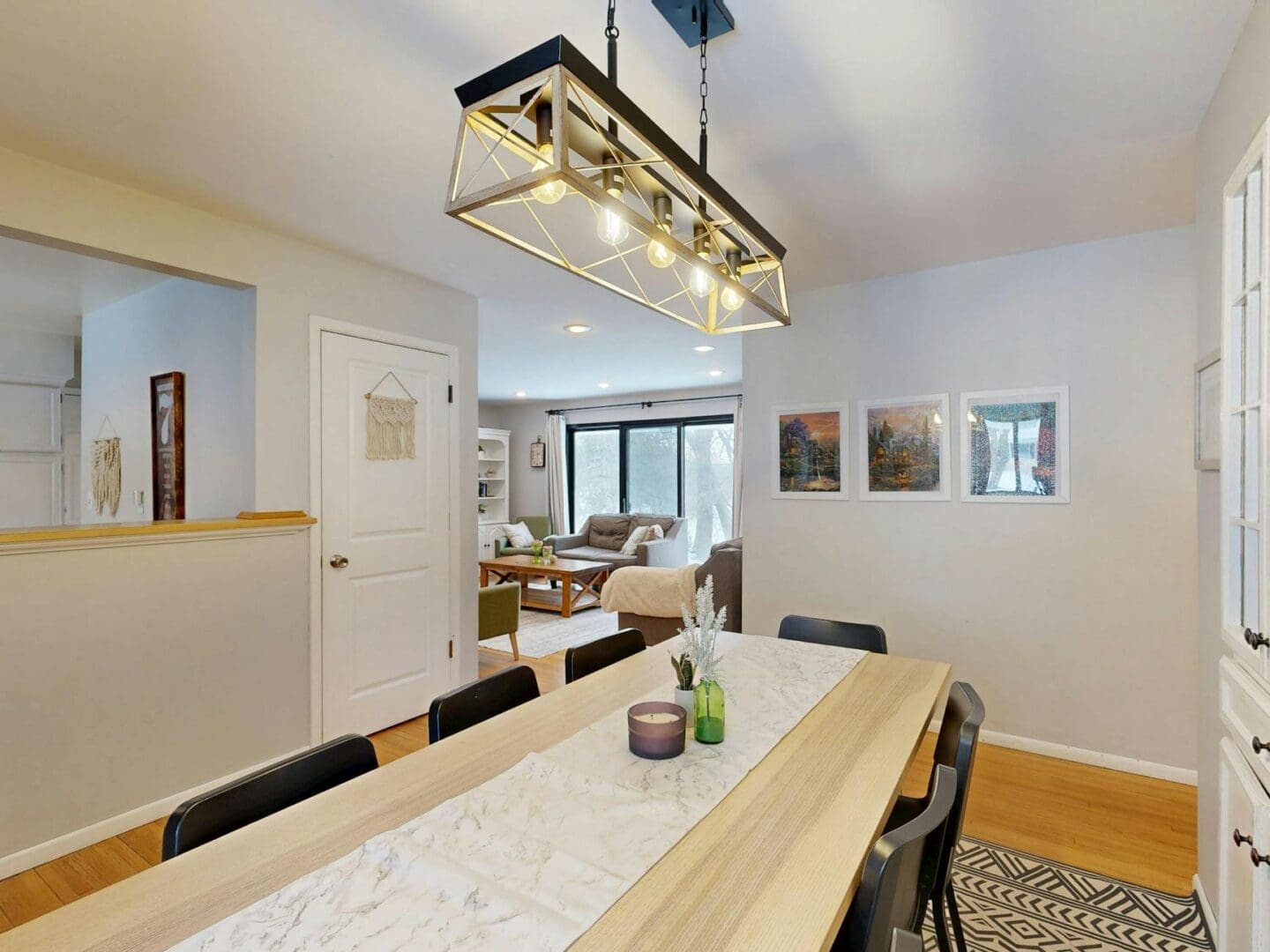
While your kitchen likely has recessed lighting and your living room has lamps, your dining area needs its own lighting moment. A chandelier or pendant light hung 30-36 inches above your table surface creates a ceiling that exists only for the dining zone.
Scale matters tremendously. A fixture that’s too dainty gets lost in a large open space. For rectangular tables, consider a linear chandelier or a series of pendants that echo the table’s length. For round tables, a single statement pendant or drum chandelier works well. The fixture should be roughly one-half to two-thirds the width of your table.
Install a dimmer switch so you can adjust the mood from bright family dinners to intimate gatherings. This flexibility helps your dining zone adapt to different uses throughout the day.
Add Supporting Players That Reinforce the Zone
Once your table, rug, and lighting are in place, smaller furniture pieces help strengthen the dining zone’s borders. A console table or sideboard against a nearby wall provides storage and serving space while creating a subtle boundary. Bar carts positioned at the edge of your dining area add function and act as visual markers.
Consider a low bookshelf or room divider if your dining area needs more separation from living spaces. These shouldn’t feel like walls—aim for pieces around 30-42 inches high that define space while maintaining the open feel. Plants on stands positioned near the dining zone’s perimeter also create gentle boundaries that don’t block views or light.
Creating an open concept dining space is really about giving clear signals through furniture placement, rugs, and lighting. When these elements work together, your dining area will feel purposeful and inviting rather than adrift in a sea of square footage. Start with your table size and placement, anchor it with the right rug, hang lighting that demands attention, and layer in pieces that reinforce the boundaries you’re creating.
Standing in front of your kitchen island or home bar, trying to decide between swivel and stationary bar stools, you’re probably wondering if that rotating seat is worth the extra cost—or if it’s just a gimmick. The truth is, both styles have their place, and the right choice depends on how you actually use your […]
There’s nothing worse than ordering bar stools online, waiting for delivery, and discovering they’re way too tall or awkwardly low for your counter. You’re left hunching over your breakfast or dangling your feet like a kid at the grown-ups’ table. The good news? Getting the right bar stool height is actually straightforward once you know […]
Shopping for a dining table when you have a family of six means you need something that works for Tuesday night homework sessions, weekend pancake breakfasts, and holiday dinners with grandparents—all without taking over your entire dining room. The right table makes family life easier. The wrong one? You’ll feel it every single day. Let’s […]