Living in a studio doesn’t mean you have to eat all your meals perched on the couch with a plate in your lap. With some thoughtful planning and the right furniture pieces, you can carve out a legitimate dining area that feels separate from your sleeping and living spaces—even when everything technically shares the same room.
The secret is choosing furniture that works hard for its footprint and creating visual boundaries that help define different zones. Let’s walk through exactly how to make it happen.
Choose a Table That Does Double Duty
In a studio, your dining table needs to earn its keep. A dedicated dining table that only gets used for meals is a luxury most studio dwellers can’t afford, so look for pieces that serve multiple purposes throughout the day.
Drop-leaf tables are your best friend here. They can fold down to a slim console against the wall when you’re not eating, then expand when you need the surface area. Expect to spend around $150-$300 for a solid option that’ll last. Wall-mounted fold-down tables are even more compact—they literally disappear when not in use and typically run $100-$250.
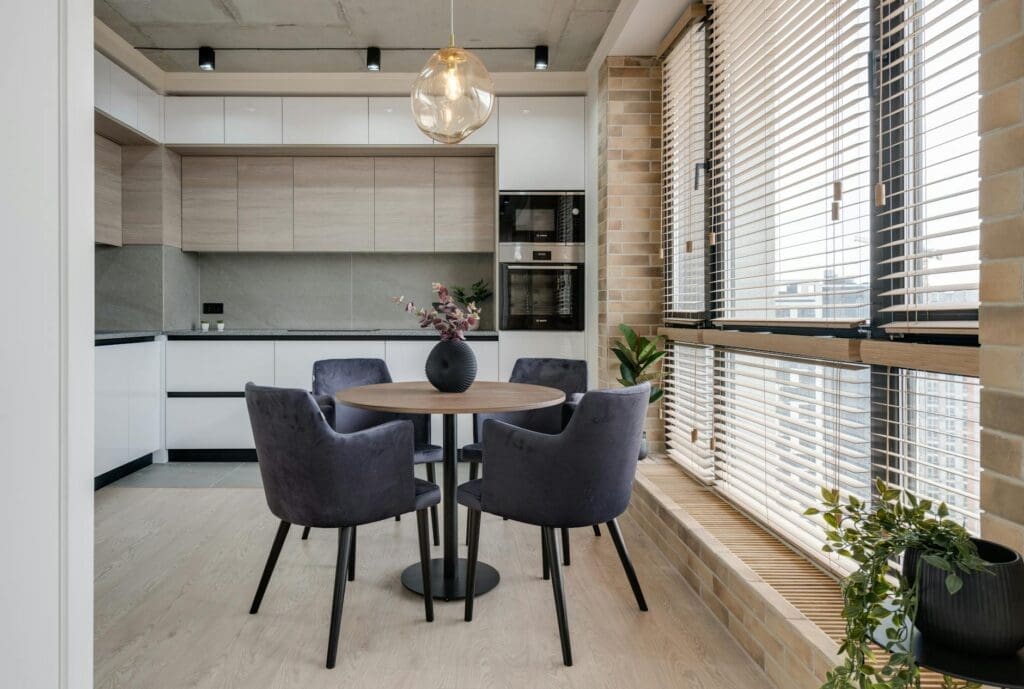
If you work from home, consider a small round pedestal table (30-36 inches diameter) that can function as both dining table and desk. The single center base means you won’t bang your knees on table legs during long work sessions. Round tables also feel less imposing in tight spaces than rectangular ones. Budget options start around $200, while mid-range pieces in solid wood run $400-$700.
For the truly space-starved, a narrow counter-height table (around 24 inches deep) pushed against a wall with a couple of stools can create a cafe-style dining nook that takes up minimal square footage.
Pick Seating That Stacks or Tucks Away
Chairs are surprisingly space-hungry, especially when you pull them out to sit down. That’s why your seating strategy matters just as much as your table choice.
Folding chairs are the obvious solution, but today’s options go way beyond rickety metal frames. Look for upholstered folding chairs or wood designs that actually look good hanging on wall hooks when not in use. You’ll find decent ones starting at $40 each, with nicer versions at $80-$120.
Stackable chairs offer similar flexibility with a more permanent feel. Molded plastic or bentwood designs can stack three or four high in a corner or closet. Brands making genuinely attractive stackable chairs typically charge $60-$150 per chair.
Backless stools deserve consideration too—they tuck completely under tables or counters, disappearing from view. A set of two runs anywhere from $80 to $300 depending on materials and construction quality.
Define the Space Without Building Walls
Creating a sense of separation helps your dining area feel intentional rather than like an awkward corner with a table shoved in it. You don’t need actual walls to achieve this.
An area rug is the simplest zone-creator. Place one under your dining table and suddenly it feels like a distinct space. A 5×7 or 6×9 rug works for most small dining setups, with prices ranging from $80 for synthetic fibers to $400+ for natural materials like jute or wool.
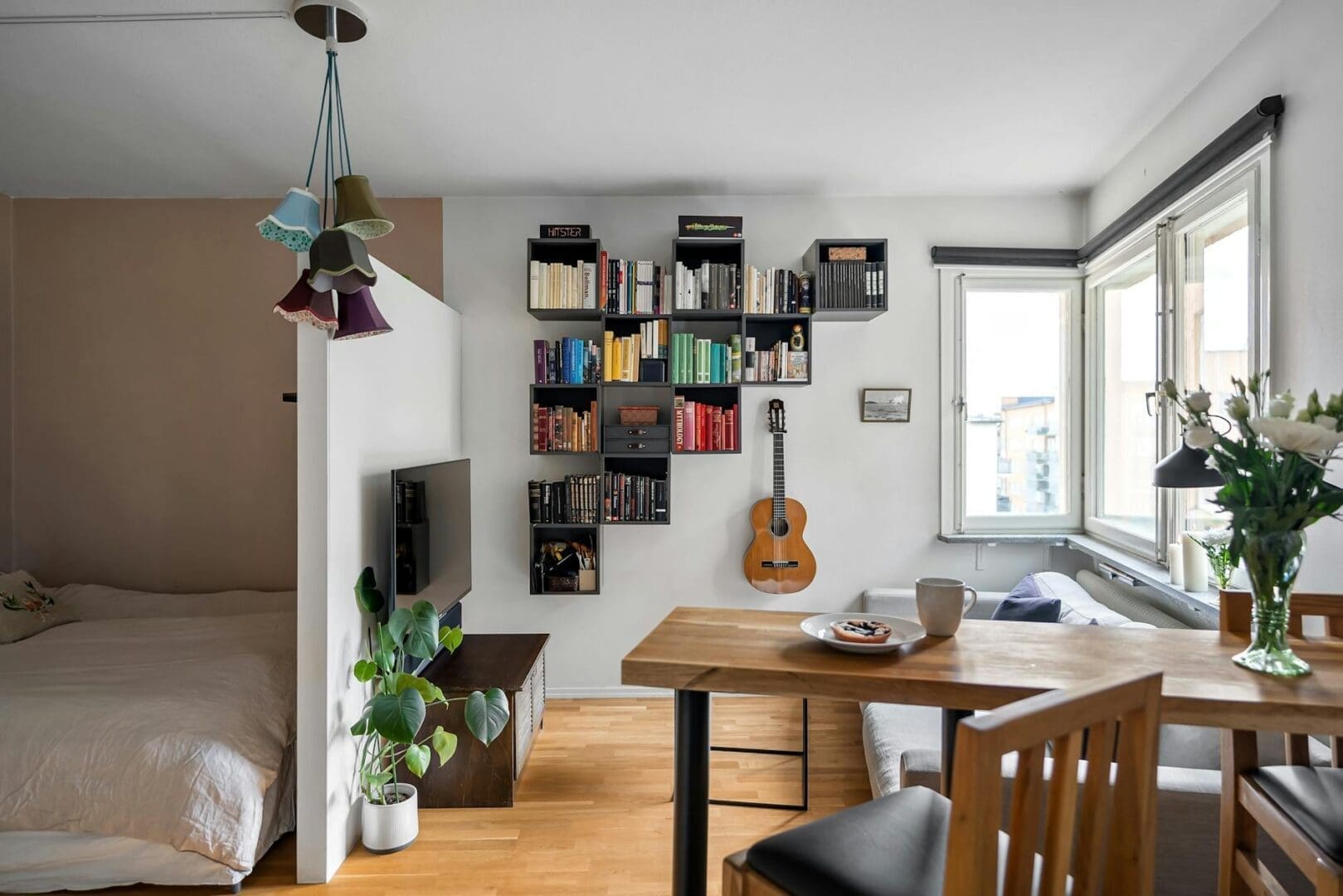
Open shelving units or bookcases positioned perpendicular to the wall can act as room dividers that separate your dining zone from your bed or sofa without blocking light. Look for pieces 30-36 inches tall so you maintain sightlines across the studio—full-height units can make small spaces feel choppy. Expect to invest $150-$400 for something sturdy.
Pendant lighting is another powerful tool. A pendant hung 30-36 inches above your table creates a visual anchor that says “this is the dining area.” Even in a studio with limited electrical options, plug-in pendant kits (around $50-$150) can hang from a ceiling hook and drape to an outlet.
Keep It Streamlined
When space is tight, visual clutter makes everything feel smaller. Stick with furniture that has clean lines and a relatively minimal footprint. Glass or acrylic tables feel lighter than solid wood—you can literally see through them, which helps the room breathe.
Storage is crucial but shouldn’t overwhelm your dining zone. A small sideboard or narrow console (under 15 inches deep) can hold dishes, placemats, and napkins while keeping your table clear between meals. Budget versions start around $150, while solid wood pieces run $400-$800.
You’ve got this. Creating a proper dining area in your studio is totally doable—it just requires furniture that works as hard as you do and a thoughtful approach to layout. Start with the right table for your space and lifestyle, add seating that doesn’t monopolize your floor plan, and use simple tricks to define the zone. You’ll be hosting dinner parties (well, dinner for two or three) before you know it.
Did You Know? The Declaration of Independence Was Likely Written in a Windsor Chair As America celebrates 250 years of independence, it’s worth looking at one of the quieter witnesses to that history: the humble Windsor chair. Thomas Jefferson is said to have drafted the Declaration of Independence while seated in an unusual revolving Windsor […]
Shopping for a dining table when you have a family of six means you need something that works for Tuesday night homework sessions, weekend pancake breakfasts, and holiday dinners with grandparents—all without taking over your entire dining room. The right table makes family life easier. The wrong one? You’ll feel it every single day. Let’s […]
If you’re working with a compact dining area, you’ve probably already discovered that square and rectangular tables can feel like furniture Tetris. Round dining tables are often the smartest solution for small spaces—they eliminate sharp corners that eat up valuable square footage, create better traffic flow, and somehow make a room feel more spacious even […]